A solo software factory
I build a multi-agent research system and the tools around it. Claude Code and Codex sessions do much of the coding; I choose the work, review the results and decide what ships. Running several sessions at once creates ordinary coordination problems: two agents edit the same file, a question waits in the wrong window, or a session runs out of context before its work is finished. This stack grew around those problems.
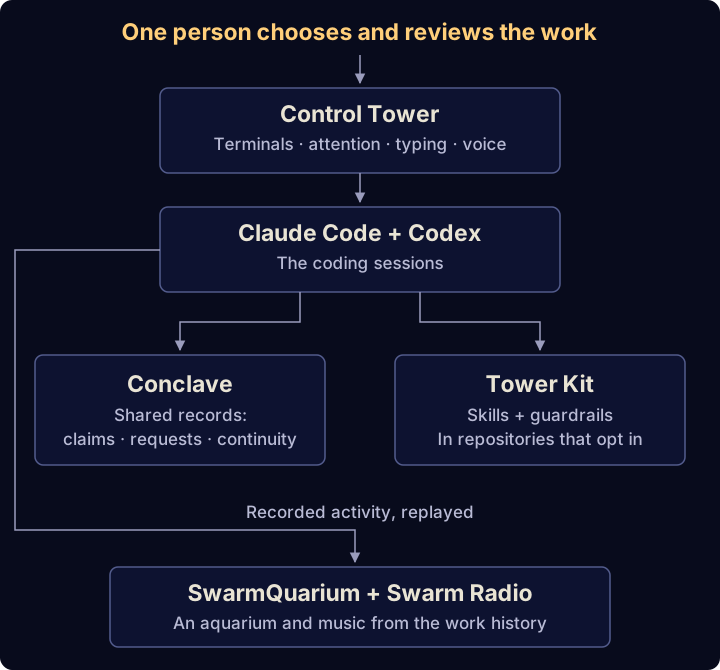
Open the diagram at full size.
What each part does
| Part | Its job |
|---|---|
| Control Tower | Keeps agent terminals, messages and attention signals in one working view, with direct typing, a scratchpad and voice input. |
| Claude Code and Codex | Run the coding sessions. I can work with both in the same repository. |
| Conclave | Records session identities, file claims, requests, replies and continuity between sessions. |
| Tower Kit | Supplies shared skills and guardrails in repositories that opt in, including checks around edits, commands and handoffs. |
| BotSwarm | The research system this tooling grew around, with local models and agents doing different jobs. |
A typical loop is small: choose a task and its acceptance check; claim the files; implement; get another session to review the result; inspect the evidence; decide whether to publish. If a session hands work on, the remaining task and obligations need to survive with it.
That is the intended workflow. A claimed file isn’t proof that every editing route enforces the claim, and a handoff record isn’t proof that the successor completed the work. The posts describe both the mechanisms and the places they failed.
What you can inspect
Most of the working stack is private. There are public pieces you can try or read:
- Claumon’s source: a small bridge from Claude Code and OpenCode to Telegram.
- SwarmQuarium: a redacted historical replay, with sessions as fish, repositories as reefs and commits as pearls.
- Swarm Radio: the same activity history composed into music.
- Several coding agents, one git checkout: concrete failures from sharing a working copy and the habits that followed.
- Hooks, not rules: why some written instructions became checks that refuse a command.
- How SwarmQuarium was built: the build history behind one public result.
The aquarium and radio show recorded activity. They don’t establish productivity, code quality or how much human attention the system saves. The marginalia are the workshop notes: what I tried, what broke and what I can support from the records.